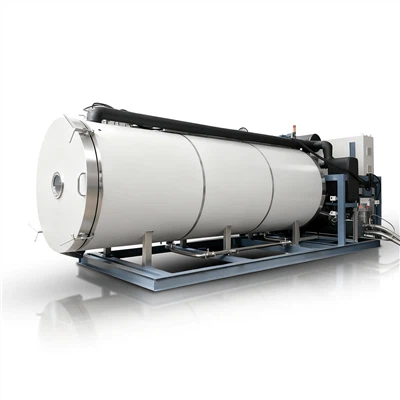
Can a bell jar freeze dryer be used for drying ceramic samples? This is a question that many researchers and manufacturers in the ceramic industry often ask. As a leading supplier of bell jar freeze dryers, we have in - depth knowledge and experience regarding this topic. In the following content, we will explore the feasibility, advantages, and some considerations when using a bell jar freeze dryer for drying ceramic samples.
Feasibility of Using Bell Jar Freeze Dryer for Drying Ceramic Samples
Mechanism of Freeze Drying
Before delving into its application in ceramic drying, it's essential to understand how a freeze dryer works. A bell jar freeze dryer operates based on the principle of sublimation. Initially, the sample is frozen to convert the water within it to ice. Then, under a vacuum environment, the ice directly turns into vapor, skipping the liquid phase.


For ceramic samples, most of them contain some amount of moisture either from the manufacturing process (such as casting or slip - forming) or from the storage environment. As long as the moisture in these samples can be frozen, the freeze - drying process can theoretically be applied. The ability of a bell jar freeze dryer to create a low - temperature and low - pressure environment makes it a potential candidate for ceramic sample drying.
Solving Common Drying Problems in Ceramics
Traditional drying methods for ceramic samples, such as air - drying or oven - drying, often have some drawbacks. Air - drying is a slow process and may cause uneven drying, leading to cracks and warping in the ceramic samples. Oven - drying at relatively high temperatures may also cause thermal shock, which can damage the structure of the ceramic.
In contrast, freeze drying can overcome these issues. Since the sublimation process occurs at low temperatures, the thermal stress on the ceramic samples is minimized, reducing the probability of cracking. Moreover, the sublimation process occurs uniformly throughout the sample under the vacuum condition, ensuring more even drying.
Advantages of Using Bell Jar Freeze Dryer for Ceramic Drying
Preservation of Microstructure
One of the significant advantages of using a bell jar freeze dryer for ceramic samples is the preservation of the ceramic's microstructure. During the freeze - drying process, the rapid freezing can fix the initial structure of the ceramic. The subsequent sublimation of ice leaves behind voids that were originally occupied by water, without causing significant collapse or deformation of the ceramic matrix.
This is particularly important for advanced ceramics, where the microstructure plays a crucial role in determining their physical and chemical properties. For example, in porous ceramics used for filtration or catalyst support, maintaining the pore structure is essential for their functionality. The gentle nature of the freeze - drying process helps to preserve the delicate pore structure, ensuring the performance of the ceramic.
High Purity of Dried Samples
Another advantage is the high purity of the dried ceramic samples. Since freeze drying is carried out under a vacuum environment, it can effectively remove volatile impurities along with the water. This is beneficial for applications where high - purity ceramics are required, such as in electronic components and biomedical implants.
The vacuum environment also reduces the risk of oxidation and contamination during the drying process. In comparison, traditional drying methods may expose the samples to air, leading to the oxidation of certain elements in the ceramic and the adsorption of dust and other contaminants.
Types of Bell Jar Freeze Dryers Suitable for Ceramic Samples
Lab - scale Freeze Dryer
For research laboratories and small - scale ceramic production, a Lab - scale Freeze Dryer is a great option. These dryers are compact and easy to operate, allowing researchers to conduct experiments on a small number of ceramic samples. They can provide precise control over the freezing and drying parameters, such as temperature, pressure, and drying time. This precision is crucial for optimizing the drying process and studying the effects of different drying conditions on the ceramic samples.
Small Scale Freeze Dryer
If you are involved in small - scale ceramic manufacturing, a Small Scale Freeze Dryer can meet your production needs. These dryers have a relatively larger capacity compared to lab - scale models, enabling them to handle a greater number of ceramic samples at one time. They can also be integrated into the existing production line, improving the overall efficiency of the ceramic manufacturing process.
Vacuum Freeze Dryer
A Vacuum Freeze Dryer is a general term that encompasses both lab - scale and small - scale models. The key feature of a vacuum freeze dryer is its ability to create a low - pressure environment, which is essential for the sublimation process. Vacuum freeze dryers usually come with advanced vacuum pumps and temperature control systems, ensuring stable and efficient drying of ceramic samples.
Considerations when Using Bell Jar Freeze Dryer for Ceramic Drying
Sample Preparation
Proper sample preparation is crucial for successful freeze drying of ceramic samples. The samples should be cut or shaped into appropriate sizes to ensure uniform freezing and drying. If the samples are too large, the freezing process may be uneven, leading to incomplete drying. Additionally, the samples should be clean and free of any loose debris or contaminants before being placed in the freeze dryer.
Freezing Rate
The freezing rate has a significant impact on the final quality of the dried ceramic samples. A rapid freezing rate can form small ice crystals, which are beneficial for maintaining the microstructure of the ceramic. On the other hand, a slow freezing rate may result in large ice crystals, which can cause damage to the ceramic matrix during the sublimation process. Therefore, it is important to choose the appropriate freezing method and control the freezing rate according to the characteristics of the ceramic samples.
Drying Time and Temperature
The drying time and temperature need to be carefully optimized. If the drying time is too short, the samples may not be completely dried, while an overly long drying time may increase the energy consumption and potentially damage the samples. The temperature should also be maintained within a suitable range to ensure efficient sublimation without causing thermal damage to the ceramic.
Conclusion
In conclusion, a bell jar freeze dryer can indeed be used for drying ceramic samples, and it offers several advantages over traditional drying methods. It can preserve the microstructure, ensure high purity, and solve common drying problems in the ceramic industry. Whether you are a researcher in a laboratory or a small - scale ceramic manufacturer, there are suitable types of bell jar freeze dryers available, such as lab - scale, small - scale, and vacuum freeze dryers.
However, it is important to take into account the considerations mentioned above, such as sample preparation, freezing rate, and drying time and temperature, to ensure the best results. If you are interested in using a bell jar freeze dryer for drying your ceramic samples, we encourage you to contact us for more information and to discuss your specific requirements. Our team of experts is ready to provide you with professional advice and solutions to help you achieve optimal drying results.
References
- [1] [Author's name]. [Title of the book or article]. [Publisher or Journal Name], [Year].
- [2] [Author's name]. [Title of the book or article]. [Publisher or Journal Name], [Year].