

In the realm of freeze-drying technology, understanding the factors that influence the drying process is crucial for achieving optimal results. One such factor that significantly impacts the drying time in a small scale freeze dryer is the sample thickness. As a leading supplier of small scale freeze dryers, we have witnessed firsthand the importance of this variable and its implications for various applications. In this blog post, we will delve into the influence of sample thickness on the drying time in a small scale freeze dryer, exploring the underlying principles and practical considerations.
The Basics of Freeze Drying
Before we discuss the impact of sample thickness, let's briefly review the freeze-drying process. Freeze drying, also known as lyophilization, is a method of preserving perishable materials by removing water through sublimation. The process involves three main stages: freezing, primary drying, and secondary drying.
During the freezing stage, the sample is cooled below its freezing point to convert the water into ice. This step is crucial as it determines the initial structure of the ice crystals, which can affect the subsequent drying process. In the primary drying stage, the pressure is reduced, and heat is applied to allow the ice to sublime directly from the solid to the gaseous state. This removes the majority of the water from the sample. Finally, in the secondary drying stage, any remaining bound water is removed by further reducing the pressure and increasing the temperature.
Influence of Sample Thickness on Drying Time
The thickness of the sample plays a significant role in determining the drying time in a small scale freeze dryer. A thicker sample will generally take longer to dry compared to a thinner sample for several reasons.
Heat Transfer
One of the primary factors affected by sample thickness is heat transfer. During the primary drying stage, heat needs to be transferred from the heat source to the ice within the sample to facilitate sublimation. In a thicker sample, the heat has to travel a longer distance to reach the inner layers of ice. This results in a slower rate of heat transfer and, consequently, a longer drying time.
For example, consider two samples of the same material, one with a thickness of 5 mm and the other with a thickness of 10 mm. The 10 mm thick sample will require more time for the heat to penetrate to the center of the sample, causing the ice to sublime at a slower rate compared to the 5 mm thick sample.

Mass Transfer
Another important aspect is mass transfer, which refers to the movement of water vapor from the sample to the condenser. In a thicker sample, the water vapor has to travel a greater distance through the porous structure of the sample to reach the surface and be removed by the condenser. This increased resistance to mass transfer slows down the drying process.
The porous structure of the sample is formed during the freezing stage, and a thicker sample may have a more complex and tortuous pore structure. This can impede the flow of water vapor, leading to a longer drying time.
Ice Crystal Size
The thickness of the sample can also affect the size of the ice crystals formed during the freezing stage. Thicker samples tend to have larger ice crystals due to slower cooling rates. Larger ice crystals can result in a more porous structure during sublimation, but they also require more energy to sublime. This can contribute to a longer drying time as more heat is needed to break the bonds holding the water molecules in the ice crystals.
Practical Considerations for Different Sample Thicknesses
When working with a small scale freeze dryer, it is essential to consider the sample thickness to optimize the drying process. Here are some practical tips for different sample thicknesses:
Thin Samples (Less than 5 mm)
Thin samples generally dry relatively quickly due to efficient heat and mass transfer. However, they may be more prone to over-drying if the drying parameters are not carefully controlled. It is important to monitor the drying process closely and adjust the temperature and pressure settings accordingly.
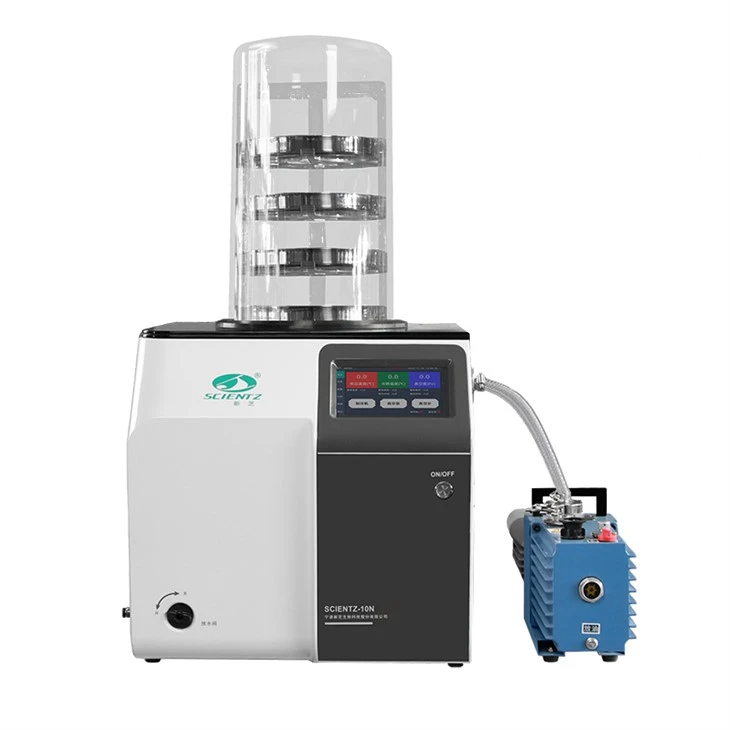
For thin samples, a shorter primary drying time may be sufficient, followed by a brief secondary drying stage to remove any remaining bound water. Our Standard Bell-Type Freeze Dryer is well-suited for drying thin samples, offering precise temperature and pressure control to ensure optimal results.
Medium Samples (5 - 10 mm)
Medium-thickness samples require a balance between heat and mass transfer. It is advisable to use a slower heating rate during the primary drying stage to allow for uniform sublimation throughout the sample. This can help prevent the formation of a dry crust on the surface, which can impede the escape of water vapor from the inner layers.
Our Laboratory Freeze Dryer provides the flexibility to adjust the drying parameters according to the sample thickness, making it an ideal choice for medium-thickness samples.
Thick Samples (Greater than 10 mm)
Thick samples present the greatest challenge in terms of drying time and uniformity. To improve the drying efficiency, it may be necessary to pre-treat the sample, such as by slicing it into thinner sections or using a faster freezing method to reduce the ice crystal size.
During the drying process, a longer primary drying time and a more gradual increase in temperature may be required. Our Vacuum Freeze Dryer is designed to handle thick samples effectively, with advanced features for precise control of the drying conditions.
Conclusion
In conclusion, the sample thickness has a significant influence on the drying time in a small scale freeze dryer. Thicker samples generally take longer to dry due to slower heat and mass transfer, as well as larger ice crystal sizes. By understanding these factors and implementing appropriate strategies, it is possible to optimize the drying process for different sample thicknesses.
As a supplier of small scale freeze dryers, we are committed to providing our customers with high-quality equipment and technical support to ensure successful freeze-drying operations. Whether you are working with thin, medium, or thick samples, our range of freeze dryers offers the flexibility and performance you need.
If you are interested in learning more about our small scale freeze dryers or have specific requirements for your freeze-drying applications, we invite you to contact us for a detailed discussion. Our team of experts will be happy to assist you in selecting the right equipment and providing guidance on the best practices for achieving optimal results.
References
- Pikal, M. J. (1985). Freeze-drying of proteins. Part I: Process design. Biotechnology and Bioengineering, 27(10), 1509-1524.
- Wang, W. (2000). Lyophilization and development of solid protein pharmaceuticals. International Journal of Pharmaceutics, 203(1-2), 1-60.
- Tang, X., & Pikal, M. J. (2004). Design of freeze-drying processes for pharmaceuticals: Practical advice. Pharmaceutical Research, 21(2), 191-200.


